


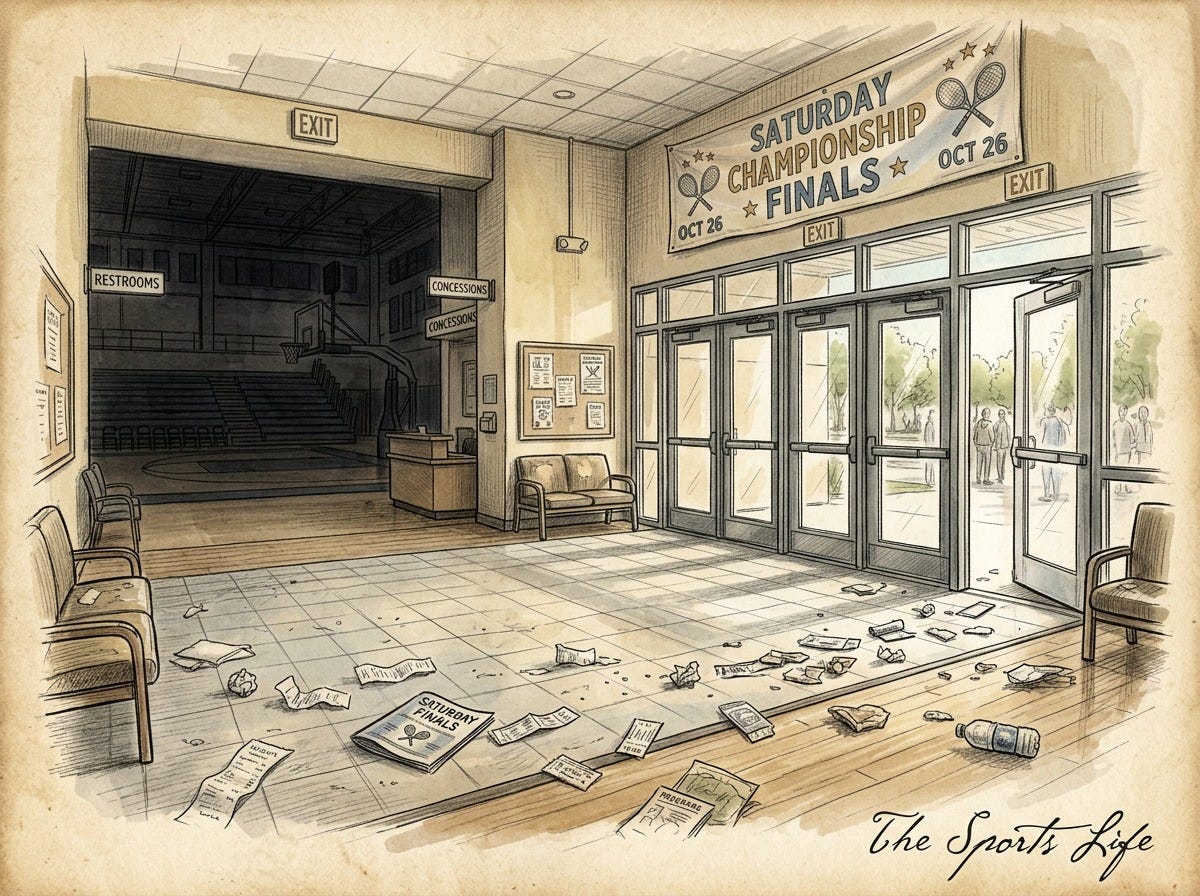
There is a sound a full sports facility makes on a Saturday morning. Ten courts going at once, whistles layered over whistles, a hundred parents sitting in portable bleachers. I spent 15 years inside that sound. It is the sound of a realized first game, and if you run a facility, a league, or an event, it is the sound you built your whole operation to produce.
Here is the question I learned to ask on Monday morning.
Where did everybody go?
On Saturday your building held two thousand people who care intensely about what happens inside it. By Monday morning your relationship with almost all of them is a receipt tossed on the floor on the way out. They were in your building, on your courts, wearing your event’s name, and then they walked out the door and became strangers again until the next registration announcement.
The facility was full and the business went home with the customers.
That gap is not a marketing problem. It is the defining structural fact of recreational and youth sports, and almost nobody who operates in this industry has built anything on the other side of it.
I started calling the other side the second game.
The first game is the one on the court. It has a start time, a scoreboard, and a capacity limit, and the capacity limit is the point: every revenue model built purely on the first game is a model built on square footage and Saturdays. You can raise prices, you can add courts, you can extend hours until the leagues run at midnight, and I have done all three. But the first game only exists when teams are competing on the hardwood.
The second game starts when the first one ends, and it has no capacity limit. It is played with everything the first game produces and almost everyone throws away: the standings somebody checks from their desk on Monday, the stat line a player screenshots for a group chat, the highlight a parent sends to a grandmother three states away, the rivalry that gives a Tuesday-night team a reason to care about a Thursday-night team.
Games create data. Data creates attention. Attention, handled with care, becomes a relationship that does not expire when the parking lot empties.
And a relationship that survives the week is the only thing in this industry that converts into revenue without requiring another square foot of hardwood.
I knew this early at Ultimate Hoops, back when it was six teams and a rented gym. If UH was going to be different, and different was the only way it was going to be profitable, we could not sell what every rec league in America sold: one hour, one night a week, see you next Tuesday.
We had to transform a recreational basketball league into a 365-day, seven-day-a-week experience.
That is why, long after the last game ended and the building emptied, I was up until four in the morning making content: recaps, stats, player pages, the story of a Tuesday night told back to the people who had lived it. The brand had to be bigger than playing the game.
My motto, repeated until people were tired of hearing it: playing an Ultimate Hoops game should be the least interesting part of Ultimate Hoops. The game was one hour. Everything we built lived in the other 23 hours.
A guy who plays in your league is a customer. A guy who checks his career scoring average from his desk at lunch is something more than that, and he renews at a rate that makes the first guy look like a stranger.
When you reach the level where the game is the least interesting part of your league, you have created something special. The economics change shape there, and not before.
Most operators never make that turn, and I understand why. The first game is urgent. The second game is never urgent. Nobody calls you at 6 a.m. because you failed to give a fourteen-year-old’s season a digital life. The cost of ignoring it shows up nowhere on this month’s P&L. It shows up three years later, as flat renewal rates and a marketing budget spent reacquiring people you already had.
Meanwhile the data walks out the door every weekend. Somebody else’s technology stack gets the highlight. A social platform gets the attention. The group chat gets the community. The operator who created all of it gets a facility rental fee.
If you run distribution, the second game is not a side project or a someday. It is the difference between owning a venue and owning an audience. Venues appreciate slowly and demand capital forever. Audiences compound.
The honest caveat is that the second game is a real build. It needs the data captured, the content made, the relationship tended, and none of that happens because you bought an app. It happens because someone decided Monday matters as much as Saturday and rebuilt the operation around that belief.
And the raw material is already yours. It was in the building last weekend, making all that noise.
The first game fills your facility. The second game is the one that decides what your business is worth.